
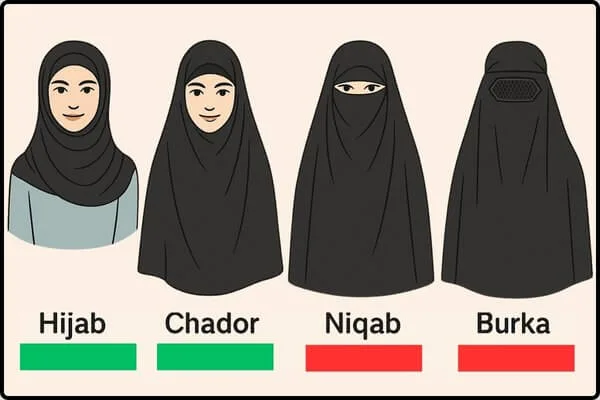
Last week, the Portuguese parliament approved a bill that would ban face coverings in most public spaces, including the burqa and niqab, garments worn by some Muslim women. This is spirituality without fear: a woman’s right to exist in public without hiding behind someone else’s idea of modesty.
It’s not law just yet; the president still has to sign it or refer it for constitutional review. Even so, the public response here in Portugal has been swift and emotional, with spirited debate unfolding across the country.

As an American living in Portugal, and an emotions therapist who works closely with people navigating shame and self-doubt, I’ve been paying close attention to these conversations. I don’t usually wade into legislative issues, but this one intersects with the emotional terrain I explore every day.
My work revolves around helping people unlearn harmful messages about their worth. And when I think about what it means to be told, from an early age, that your face, your body, your presence must be hidden, not out of personal choice, but as a rule, that’s not cultural expression to me. That’s erasure.
Portugal would be joining several other European nations in implementing a ban on the burka and niqab in public spaces. As someone rooted in American ideals of personal freedom, but also a European resident committed to human rights and dignity, I find myself in full agreement with this decision. It’s not about banning religion. It’s about drawing a firm line against systems that erase women… literally and symbolically.
This Is Erasure, Not Culture
Let’s be clear. The burka and the niqab are not simply cultural garments. They are not equivalent to a fashion choice or an expression of modesty in the way some people try to frame them. These garments, when imposed (and they are overwhelmingly imposed), are tools of subjugation dressed up as devotion, not an authentic expression of faith.
They teach girls from the earliest age that their visibility is shameful… that their faces, their bodies, even their eye contact, must be hidden because their mere existence might provoke or offend. Shame, layered on shame, justified by a warped interpretation of faith that ignores the crushing weight of guilt and denies them a spirituality without fear.
I do not work with Muslim women directly. But I know shame when I see it. I work with people who carry shame for who they are, who they love, what they’ve done, or the weight of toxic cycles in our relationships. I can only imagine the psychological landscape of someone raised with the belief that her body is a threat – that her voice, her skin, her gaze, are all things that must be suppressed or sanctioned. That she must be erased to be worthy.

When people say banning the burka or niqab is oppressive, I want to ask: oppressive to whom? To the women forced to wear them? Or to the ideology that depends on their silence and disappearance?
The United States currently has no federal law banning the burka or niqab, though TSA or federal airport security can ask for removal for identification/security purposes (just like they may ask anyone with a full face covering) but that’s not the same as a law banning the garment.
Here in Portugal, the conversation is shifting. And while this law (when enacted) may not fix everything, and certainly won’t end the broader issues of gender inequality, it does something crucial: it refuses to look away. It says: in our public spaces, all people must be seen. And that includes women. This is about reclaiming a sense of sacredness.
The burka is not just cloth. It’s a symbol of erasure. It communicates that a woman’s value lies not in her mind, her words, her contributions, but in her ability to disappear. True faith is finding a deep internal peace. And yes, I know the counter-arguments. Some say it’s empowering, a personal choice. But I also know that if your “choice” is made under the weight of shame, under threat of social exclusion or worse, it’s not a free choice. It’s survival.
Choosing a spirituality without fear
Europe is not perfect. Portugal is not perfect. But banning the burka and niqab in public spaces is not about perfection. It’s about protecting a basic, non-negotiable standard: that no woman should be told her existence is something to be hidden. That her freedom to be seen, to speak, to breathe in public without a mask of shame, is sacred.
This law doesn’t reject faith. It rejects fear disguised as faith. It rejects any system that tells a girl she must disappear to be righteous.
In my work, I help people reclaim themselves from the weight of silence. Portugal’s legislation is, in its own way, an act of reclamation, not of territory, not of politics, but of personhood.
And I’m here for that.
With Love,
Becca
P.S. On a totally different subject, mark your calendars for our next Cannabis Elevation Ceremony, Sunday, November 16th. If you want to put your iron in the fire now, you can register here.
Join the conversation
This piece is part of an ongoing conversation over on Facebook, where our community gathers. Add your voice there — or, if you’d rather share something just with Becca, send a private note.
Becca Williams
Emotions Therapist & Registered Dietitian
An Emotions Therapist, Registered Dietitian/Nutritionist, educator, group facilitator, and longtime plant medicine advocate.
More about Becca