

Emotional Triggers: Why You React the Way You Do - and How to Finally Change It
Most of us can hold it together. Until we can’t. Becca Williams, credentialed Emotional Liberation practitioner and plant medicine facilitator, explains why emotional triggers are not character flaws, and how working with them leads to finally being in the driver’s seat of your own reactions.
Becca Williams
Emotions Therapist & Registered Dietitian
Published April 7, 2023 | Last Updated October 18, 2026
The wound underneath the mask
Most of us are functional. We get through our days. We show up, manage, hold it together.
But underneath that capable exterior, many of us are also carrying a wound. And under enough stress, that wound erupts and takes over in ways that can surprise even us.
You may know the feeling. Something happens, it can be any number of things, a tone of voice, a look, a word, a situation that feels suddenly unbearable, and before you’ve had time to think, you’ve reacted. You’ve said something you regret, shut down completely, or gone somewhere inside yourself that no one can reach.
Afterward, you look around at what just happened and wonder: why do I do that? Why do particular things set me off like that?
That’s one of the central questions the Emotional Liberation work is designed to answer and resolve.
What a trigger actually is
A trigger is not a weakness. It’s an outdated reaction but, back in the day for you, it was an ingenious survival mechanism.
Here’s how it works: when something painful happened, often long ago, the memory got stored in the subconscious, out of your conscious control. Then, when a situation arises in the present moment that resembles something stored in that database of past harm, an alarm sounds. And what follows is a flood of defensive reactions starting with the same emotions that you felt way back when.
The subconscious is fiercely loyal but not very discerning. It has no sense of time. It cannot tell the difference between your parent and your partner, between then and now, between who you were and who you’ve become.
So when something triggers you, it’s not the capable adult who shows up to respond. It’s an earlier version of you, leaning into the only behavior that kept you safe at the time.
The two wounded selves
This is especially visible in relationships.
When you’re triggered, you’re not actually talking to the person in front of you. You’re responding to someone from the past. And if the person across from you is also triggered – their wounded self is responding to your wounded self.
Two scared, reactive, younger selves are now in a room together. Neither has access to the intelligence, patience, or generosity of their adult self. Nothing gets resolved between those two echoes of the past.
This is why the same argument keeps happening. Why certain dynamics feel inescapable. Why people who love each other can keep hurting each other in the same ways, no matter how many times they promise it will be different.
The patterns repeat until they’re understood. This insight is foundational to the Emotional Liberation method.
What patterns are – and why they repeat
That repetition isn’t failure – it’s the mechanism of learning. The goal of the Emotional Liberation® work is not to suppress your reactions. It’s to understand them so completely that you can replace automatic reactivity with conscious choice. That’s what it means to be trigger-free: not emotionally numb, not unfeeling, but genuinely in the driver’s seat of your own responses.
Your past, other people, passing thoughts and shifting moods will no longer send you off the rails. Feelings will serve your purpose rather than hijack it.
“A trigger is not a flaw. It’s an outdated alarm system doing the only job it ever knew how to do. The work is teaching it that things have changed.”
– Becca Williams
What the research says
The neuroscience of triggers confirms what practitioners have observed for decades. Trauma and chronic stress alter the brain’s threat detection systems, particularly in the amygdala and hippocampus, making it harder to distinguish between past danger and present safety.[1]
An fMRI meta-analysis of 580+ children across 14 studies found that childhood trauma disrupts neural networks involved in emotional processing, sense of self, and cognitive control — and that these effects persist into adulthood unless directly addressed.[2]
A 2024 meta-analysis of randomized controlled trials confirmed that mind-body practices integrating intentional movement with inner awareness consistently reduce anxiety — working at the level where the patterns actually live.[3]
How the Emotional Liberation work addresses triggers
In our Emotional Liberation® work, we don’t just manage triggers. We trace them to resolve them.
We start with the thinking – understanding what a trigger actually is, where it comes from, and why the subconscious has been protecting you so fiercely. A key tool is the Reactions Self-Analysis: a structured process of mapping the trigger, the emotion it activates, the thoughts that follow, the behavior, and crucially, the earlier memory underneath it all. Each piece leads toward the source.
When you find the source, you can update it. The subconscious learns that things have changed.
Where healing meets real life
As you develop a working relationship with your triggers, something shifts in the texture of daily life.
Situations that used to hijack you become navigable. The old reactive loop – trigger, flood, regret – starts to slow down. There’s a pause where there used to be only reaction. In that pause, you have a choice.
Your relationships change. Because you’re no longer arguing as two wounded children. You’re actually present. So are they.
The Emotional Liberation work harmonizes with your needs, whether triggers are showing up in specific relationships or whether reactivity has been a pattern your whole life. You don’t navigate it alone – I work with people in one-to-one sessions, groups, retreats, and ceremonial gatherings.
For some, plant medicine is part of this work, accelerating access to the deeper emotional material that drives the patterns. You can learn more about how I work with cannabis and psilocybin .
There is something uniquely powerful about doing this work in community, and it complements one-to-one work beautifully.
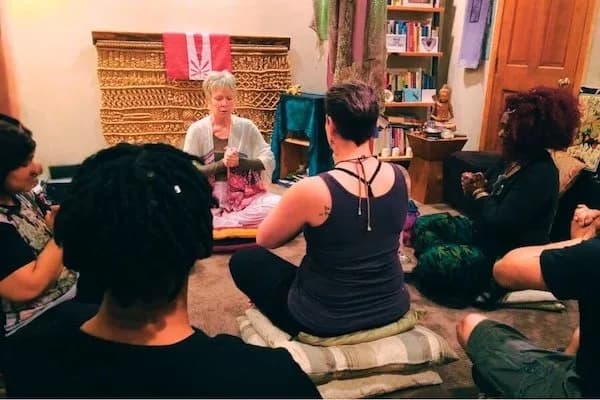
My group masterclasses, trainings, retreats, and ceremonial gatherings create a dynamic that accelerates emotional healing. When people do this work together, the healing goes deeper – witnessing and being witnessed is its own powerful medicine.
We also know that triggers don’t stay private. They show up in how you lead, how you teach, how you hold space for others. Teachers and facilitators often find this work particularly valuable. Understanding these patterns in yourself makes you more effective in teaching them to others.
Sources
- Bany-Mohammed, M., Asim, S., Elalami, M., & Agrawal, D. K. (2025). Trauma, Stress, and Mental Health Outcomes. Journal of psychiatry and psychiatric disorders, 9(5), 276–288. https://doi.org/10.26502/jppd.2572-519X0260
- Ireton, R., Hughes, A., & Klabunde, M. (2024). A Functional Magnetic Resonance Imaging Meta-Analysis of Childhood Trauma. Biological psychiatry. Cognitive neuroscience and neuroimaging, 9(6), 561–570. https://doi.org/10.1016/j.bpsc.2024.01.009
- Lin, X., Zheng, J., Zhang, Q., & Li, Y. (2024). The effects of mind body exercise on anxiety: A systematic review and meta-analysis of randomized controlled trials. Mental Health and Physical Activity, 26, 1–13. https://doi.org/10.1016/j.mhpa.2024.100587
Common Questions
Questions people often ask
Can triggers really be resolved, or do I just learn to manage them?+
Both – and more. In the beginning, the work is about developing awareness and new responses. You’re building the pause between trigger and reaction. That alone changes everything.
Over time, as you trace the trigger to its origin and work with what’s there at the source, the charge diminishes. Something that used to derail you completely becomes a mild discomfort. Then a passing sensation. Then nothing at all.
Trigger-free doesn’t mean emotionally flat. It means your past no longer has veto power over your present. Feelings still move through you – they just don’t take over.
How does Becca work with relationship patterns?+
Sessions work with this at the root level: somatic, experiential, and integrative. The approach is non-pathologising and non-clinical: it works with the whole person, not a diagnosis.
See how sessions work →
How quickly do people notice a difference?+
The timeline varies. Some people feel a significant shift early in the work. For others – particularly those for whom trauma has been a lifelong companion, woven through early experiences and repeated wounds – the work is slower, more layered, and asks for more patience. That’s not a limitation. That’s the nature of healing something that runs this deep.
What I can tell you is that the capacity for change doesn’t have an expiration date.
If you’re wondering whether working with me is a good fit for you, the best next step is a complimentary Discovery Session . You’ll complete a client intake form first, then we’ll meet on Zoom to explore what’s possible.
How long before I notice a difference?+
Many people feel a significant shift early in the work, a quality of stillness, relief, or release they may not have experienced before. But the work is not only about feeling better in the moment. It also involves developing a clearer cognitive understanding of your emotions: what you are feeling, where it comes from, how it affects your nervous system, and the patterns that keep it in place.
Over time, with consistent practice, that understanding becomes more embodied. Eleven minutes a day is enough to begin building new neural pathways and training the nervous system to respond differently. The practice builds on itself. What starts as relief in a session can gradually become greater awareness of your emotional patterns, more choice in how you respond, and a different way of moving through your life.
I understand my emotions intellectually. Why can’t I seem to change them?+
Because understanding and feeling are two different things – and healing happens at the level of feeling.
The nervous system runs its patterns independently of what the thinking mind knows. You can have complete insight into why you react a certain way and still find the same reactions arising. That’s not a failure of intelligence, it’s a description of how the nervous system works. That’s why the Emotional Liberation work engages the nervous system directly – through movement, breath, sound, and psycho-spiritual inquiry.
If you’re wondering whether this work is a good fit for you, the best next step is a complimentary Discovery Session. You’ll complete a client intake form first, then we’ll meet on Zoom to explore what’s possible.
Ready to stop reacting and start responding?
Sessions work with emotional triggers through psycho-spiritual inquiry, expressive movement, and conscious plant medicine.